Overall: I’m honestly surprised that when The Traveler re-emerged in his dining room, he didn’t look like Robin Williams in Jumanji.
Night falls on the forest where Weena and the Traveler have found themselves, and as they wander (trying to make their way back to the White Sphinx, where the time machine went missing) they are set upon by Morlocks. As they’re being carried off though, the time traveler begins to fight back. At first he lights the camphor, and then a nearby tree. However, he seems to be knocked out and when he wakes up he’s being carried off by Morlocks.
From here this chapter got surprisingly violent. Like, traveler begins bludgeoning these things with his crowbar and he fucking relishes it! After downing a few Morlocks, he finds that he’s slowly able to see them in the darkness and that they’re running around him and away from him. As the sky lights up he realizes that the tree he had set alight has now caught the whole forest on fire, causing the Morlocks to all run away. Eventually the traveler and the Morlocks take refuge from the flames (I think on a hilltop, which isn’t how fires work, but whatever).
As the day breaks, the traveler ties grass to his feet (really) to avoid singing them on the remnants of the fire, and he realizes that Weena is apparently dead. He notes that he has some odd detachment from this in his retelling of the event, because he’s apparently spent a fair amount of time already mourning her in the future. However, it’s still sad. I’m not quite sure if Weena’s dead though… we didn’t see a body or anything, it’d be kind of strange to kill basically the only character with a name off page.
Saturday, July 16, 2016

The Time Machine - Chapter 8
Overall: Kinda feels like setup. A cool setpiece though
Well, it turns out the Palace of Green Porcelain is some kind of museum/library place. Wandering around in it, the Traveler and Weena try to find something that might help them against the Morlocks. The whole scene felt very much to me like something out of The Last of Us, with there apparently being Morlocks lurking somewhere in the building, and our two protagonists having to avoid their notice. Eventually, the Traveler finds some matches and a bottle of camphor oil, as well as an iron crowbar that he hopes to use in opening a pair of bronze doors.
Much of the rest of this chapter though, feels somewhat like relationship building between Weena and The Traveler. There’s a really bizarre sequence midway through the middle in which the two of them dance to a tune that the Traveler whistles. While that might be a cute scene elsewhere, it really just feels a bit out of place in the midst of this abandoned building exploration.
Also, the Traveler’s getting more and more bloodthirsty as the fight with the Morlocks looms ahead. He almost decides to leave Weena so that he could go kill the Morlocks he hears in the museum using the crowbar but he decides against it. Wondering how this will progress.
Finally, I’m going to predict that he left himself the matches and camphor oil. He remarks upon how unusual it was to find the items there, and I think it’ll end up being a sort of time loop being created.
Well, it turns out the Palace of Green Porcelain is some kind of museum/library place. Wandering around in it, the Traveler and Weena try to find something that might help them against the Morlocks. The whole scene felt very much to me like something out of The Last of Us, with there apparently being Morlocks lurking somewhere in the building, and our two protagonists having to avoid their notice. Eventually, the Traveler finds some matches and a bottle of camphor oil, as well as an iron crowbar that he hopes to use in opening a pair of bronze doors.
Much of the rest of this chapter though, feels somewhat like relationship building between Weena and The Traveler. There’s a really bizarre sequence midway through the middle in which the two of them dance to a tune that the Traveler whistles. While that might be a cute scene elsewhere, it really just feels a bit out of place in the midst of this abandoned building exploration.
Also, the Traveler’s getting more and more bloodthirsty as the fight with the Morlocks looms ahead. He almost decides to leave Weena so that he could go kill the Morlocks he hears in the museum using the crowbar but he decides against it. Wondering how this will progress.
Finally, I’m going to predict that he left himself the matches and camphor oil. He remarks upon how unusual it was to find the items there, and I think it’ll end up being a sort of time loop being created.
The Time Machine - Chapter 7
Overall: The Traveler comes to a horrifying revelation, and contemplates it.
This is a slower chapter than the previous one (would’ve been kind of surprised if it had kept that momentum, honestly) but one that I think is necessary. After escaping the clutches of the Morlocks, the traveler spends some time wandering about with Weena, and trying to avoid the realization that’s dawning on him: that the Morlocks’ diet is the Eloi.
At this point, I wouldn’t be surprised if the book goes with this, or if this turns out to be another misdirect. The Traveler’s already made two guesses about the society surrounding him that he’s rethought, so maybe this one will turn out to be another feint. Even so, the traveler is frightened enough that he’s dreading the new moon, which the Eloi seem to fear as well, as it indicates when the Morlocks will come above ground and likely feed on the upper-landers. The Traveler decides that he’d best arm himself with some sort of torch for when the new moon comes along.
One thing that’s been brought up in a few chapters at this point is the Palace of Green Porcelain, which the Traveler and Weena pass at various points. The place seems to be locked up but I’m excited to see what’s in it, as it’s what the traveler is now aiming to access.
Also, I really hope the traveler doesn’t form some sort of romantic attachment to Weena. She’s consistently described in childlike terms and it’d be really creepy if he does. He seems to mostly be treating her alright for now, like an adult who’s just found themselves wandering around with a child ought to behave (protective/indulging, I guess) but I don’t have much confidence in old books for this kind of thing to continue
This is a slower chapter than the previous one (would’ve been kind of surprised if it had kept that momentum, honestly) but one that I think is necessary. After escaping the clutches of the Morlocks, the traveler spends some time wandering about with Weena, and trying to avoid the realization that’s dawning on him: that the Morlocks’ diet is the Eloi.
At this point, I wouldn’t be surprised if the book goes with this, or if this turns out to be another misdirect. The Traveler’s already made two guesses about the society surrounding him that he’s rethought, so maybe this one will turn out to be another feint. Even so, the traveler is frightened enough that he’s dreading the new moon, which the Eloi seem to fear as well, as it indicates when the Morlocks will come above ground and likely feed on the upper-landers. The Traveler decides that he’d best arm himself with some sort of torch for when the new moon comes along.
One thing that’s been brought up in a few chapters at this point is the Palace of Green Porcelain, which the Traveler and Weena pass at various points. The place seems to be locked up but I’m excited to see what’s in it, as it’s what the traveler is now aiming to access.
Also, I really hope the traveler doesn’t form some sort of romantic attachment to Weena. She’s consistently described in childlike terms and it’d be really creepy if he does. He seems to mostly be treating her alright for now, like an adult who’s just found themselves wandering around with a child ought to behave (protective/indulging, I guess) but I don’t have much confidence in old books for this kind of thing to continue
Saturday, July 9, 2016
The Time Machine - Chapter 6
Overall: Well that was horrifying (TW for nyctophobia)
It occurred to me even then, that in the course of a few days the moon must pass through its last quarter, and the nights grow dark, when the appearances of these unpleasant creatures from below, these whitened Lemurs, this new vermin that had replaced the old, might be more abundant
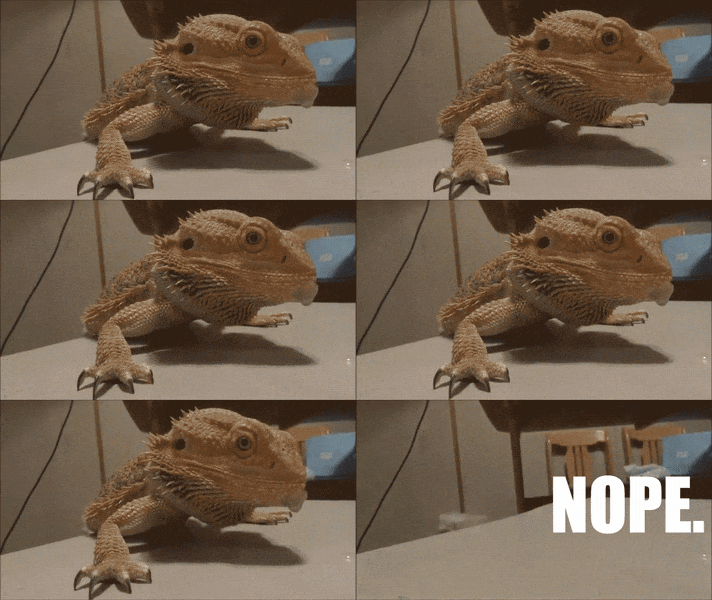
The descent was effected by means of metallic bars projecting from the sides of the well, and these being adapted to the needs of a creature much smaller and lighter than myself, I was speedily cramped and fatigued by the descent. And not simply fatigued! One of the bars bent suddenly under my weight, and almost swung me off into the blackness beneath.
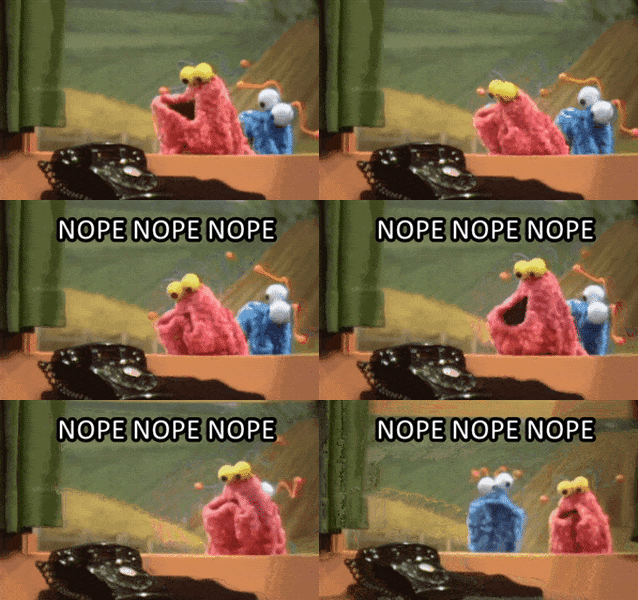
‘I do not know how long I lay. I was roused by a soft hand touching my face. Starting up in the darkness I snatched at my matches and, hastily striking one, I saw three stooping white creatures similar to the one I had seen above ground in the ruin, hastily retreating before the light.
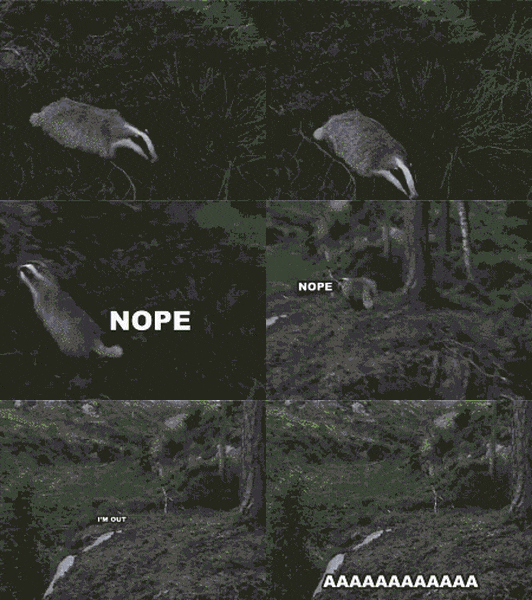
But, so soon as I struck a match in order to see them, they fled incontinently, vanishing into dark gutters and tunnels, from which their eyes glared at me in the strangest fashion.
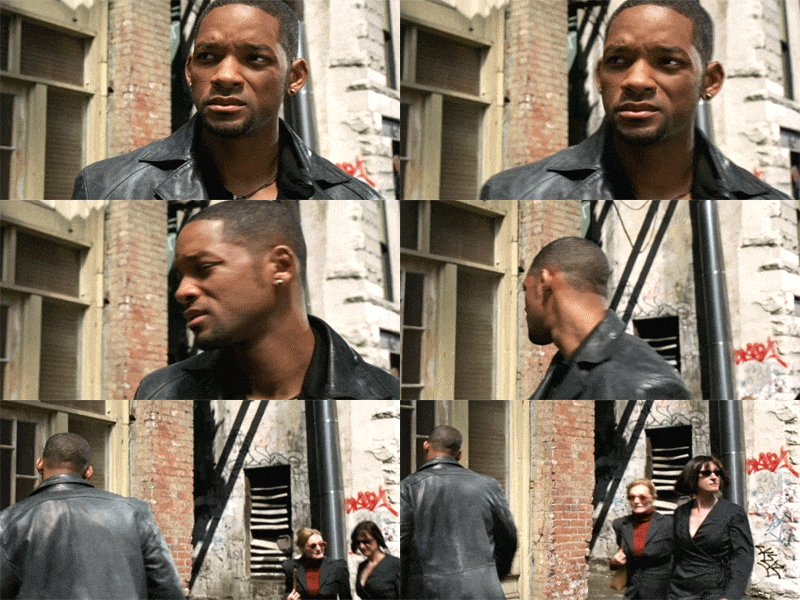
Some way down the central vista was a little table of white metal, laid with what seemed a meal. The Morlocks at any rate were carnivorous! Even at the time, I remember wondering what large animal could have survived to furnish the red joint I saw.

and it was only with my last glimpse of light I discovered that my store of matches had run low
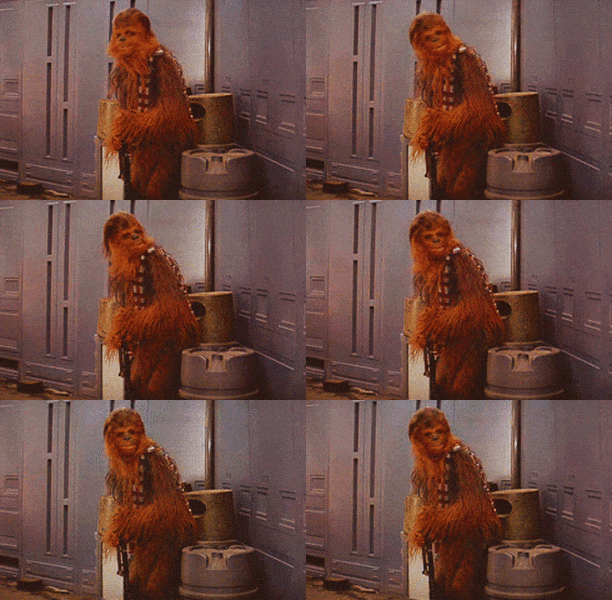
Now, as I say, I had four left, and while I stood in the dark, a hand touched mine, lank fingers came feeling over my face, and I was sensible of a peculiar unpleasant odour. I fancied I heard the breathing of a crowd of those dreadful little beings about me
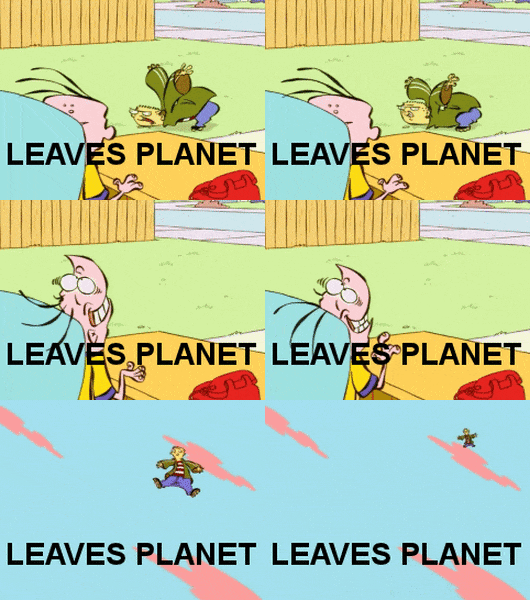
‘In a moment I was clutched by several hands, and there was no mistaking that they were trying to haul me back. I struck another light, and waved it in their dazzled faces. You can scarce imagine how nauseatingly inhuman they looked—those pale, chinless faces and great, lidless, pinkish-grey eyes!’

I disengaged myself from the clutches of the Morlocks and was speedily clambering up the shaft, while they stayed peering and blinking up at me: all but one little wretch who followed me for some way, and well-nigh secured my boot as a trophy
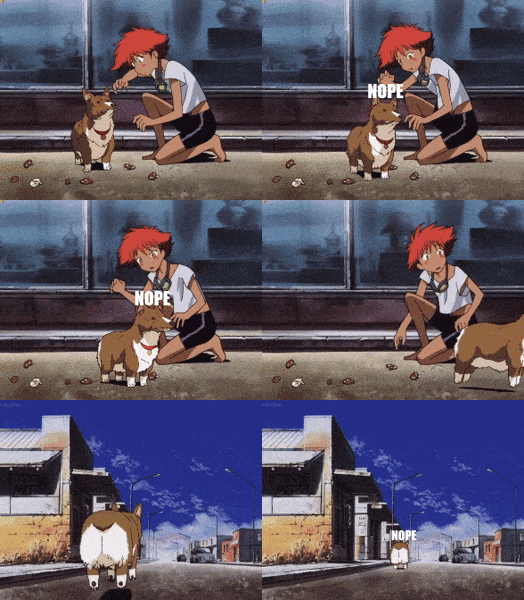
It occurred to me even then, that in the course of a few days the moon must pass through its last quarter, and the nights grow dark, when the appearances of these unpleasant creatures from below, these whitened Lemurs, this new vermin that had replaced the old, might be more abundant
The descent was effected by means of metallic bars projecting from the sides of the well, and these being adapted to the needs of a creature much smaller and lighter than myself, I was speedily cramped and fatigued by the descent. And not simply fatigued! One of the bars bent suddenly under my weight, and almost swung me off into the blackness beneath.
‘I do not know how long I lay. I was roused by a soft hand touching my face. Starting up in the darkness I snatched at my matches and, hastily striking one, I saw three stooping white creatures similar to the one I had seen above ground in the ruin, hastily retreating before the light.
But, so soon as I struck a match in order to see them, they fled incontinently, vanishing into dark gutters and tunnels, from which their eyes glared at me in the strangest fashion.
Some way down the central vista was a little table of white metal, laid with what seemed a meal. The Morlocks at any rate were carnivorous! Even at the time, I remember wondering what large animal could have survived to furnish the red joint I saw.
and it was only with my last glimpse of light I discovered that my store of matches had run low
Now, as I say, I had four left, and while I stood in the dark, a hand touched mine, lank fingers came feeling over my face, and I was sensible of a peculiar unpleasant odour. I fancied I heard the breathing of a crowd of those dreadful little beings about me
‘In a moment I was clutched by several hands, and there was no mistaking that they were trying to haul me back. I struck another light, and waved it in their dazzled faces. You can scarce imagine how nauseatingly inhuman they looked—those pale, chinless faces and great, lidless, pinkish-grey eyes!’
I disengaged myself from the clutches of the Morlocks and was speedily clambering up the shaft, while they stayed peering and blinking up at me: all but one little wretch who followed me for some way, and well-nigh secured my boot as a trophy
The Time Machine - Chapter 5
Overall: Well here we go, Morlocks oh my
SO I’m beginning to wonder if we’re going to go to any other time periods during this book. Almost halfway through by this point, so we’ll see I suppose. The Time Traveler goes back looking for his time machine only to find that it is missing. Frantic, he searches for it before coming upon… well, I’m not exactly sure how to describe it. It’s another type of being living in this world, called a Morlock. So, I know enough about Morlocks through cultural osmosis (and the X-men) to know that essentially they’re subterranean creatures. I googled the name and it came up with some monsters which look a lot like these guys from Rick and Morty.

The Time Traveler, again, is interesting here in that he’s less interested in the fact that these creatures exist so much as he is in figuring out what role they must play in the society of the Eloi (the name of the above-ground creatures). He begins to surmise that there’s a social stratification by which the Eloi get to live in relative splendor and peace while the Morlocks must toil away underground in some sort of factory that keeps goods supplied to the surface.
The Traveler then meets an Eloi named Weena who he, quite frankly, treats rather brusquely in trying to get information about the Morlocks from her. She’s distressed by the whole thing and the Traveler ends up placating her by lighting a match (so basically dangling his keys). He’s still unsure where the machine is, but now he’s interested in these Morlocks and hopes to find out more about them. I want to see where this goes.
The Time Machine - Chapter 4
Overall: Well that got philosophical, much more than I thought it would be.
So I’m not sure exactly what I was expecting out of this book but if this chapter is much indication (the book is only 80-some pages, so I’m coming up on halfway through) then The Time Machine is a lot more philosophically inclined than I had thought it would be. It isn’t Heidegger or anything, don’t get me wrong, but I’m comparing it to Jules Verne, who’s probably the name most often invoked alongside Wells when considering this era of science fiction.
However, at least given what I’ve read of Verne (about a quarter of Journey to the Center of the Earth), he was much more into the adventure aspect of science fiction than the more contemplative side which Shelley had introduced and, if this chapter is much to go on, Wells continued. The Time Traveler spends his time in this chapter among the people here in the future (the year 802,701!!!!) and finds them very different than he had expected. Rather than hyper-advanced polymaths, the people are diminutive and childlike. They are peaceful, vegan (as it seems most animals have died out) and generally happy and accepting of The Time Traveler. He lives among the people’s homes and takes some observer’s part in their society, finding them to be interested in him, but childlike in that they tend to lose interest quickly and go about whatever it was they had been doing.
One day, as the sun is setting, the Time Traveler comes upon a hill and proceeds upon a big moment of introspection regarding humanity and the state of the world. While some of it is kinda loaded with evolutionary psychology biofacts (blech) there is a degree of insight into what he says regarding the promulgation of the species and a somewhat peaceful/accepting view of humans at the edge of their extinction. Like, I know this was written while communism wasn’t much more than a theory, but jeez, I have to imagine this book may’ve been challenged throughout the 20th century for its fairly favorable view of these people who The Time Traveler supposes must’ve been the result of a communist restructuring of society at some point in the intervening time.
I imagine this won’t last much longer than this chapter, but it’s really interesting to me when books have these moments in them which touch on wider philosophical/political trends occurring in the world surrounding the text (it’s also why I don’t tend to subscribe to the whole “Death of the Author” thing).
Also: It just occurred to me as I read this chapter. What was the Time Traveler called before he went into the time traveling business?
So I’m not sure exactly what I was expecting out of this book but if this chapter is much indication (the book is only 80-some pages, so I’m coming up on halfway through) then The Time Machine is a lot more philosophically inclined than I had thought it would be. It isn’t Heidegger or anything, don’t get me wrong, but I’m comparing it to Jules Verne, who’s probably the name most often invoked alongside Wells when considering this era of science fiction.
However, at least given what I’ve read of Verne (about a quarter of Journey to the Center of the Earth), he was much more into the adventure aspect of science fiction than the more contemplative side which Shelley had introduced and, if this chapter is much to go on, Wells continued. The Time Traveler spends his time in this chapter among the people here in the future (the year 802,701!!!!) and finds them very different than he had expected. Rather than hyper-advanced polymaths, the people are diminutive and childlike. They are peaceful, vegan (as it seems most animals have died out) and generally happy and accepting of The Time Traveler. He lives among the people’s homes and takes some observer’s part in their society, finding them to be interested in him, but childlike in that they tend to lose interest quickly and go about whatever it was they had been doing.
One day, as the sun is setting, the Time Traveler comes upon a hill and proceeds upon a big moment of introspection regarding humanity and the state of the world. While some of it is kinda loaded with evolutionary psychology biofacts (blech) there is a degree of insight into what he says regarding the promulgation of the species and a somewhat peaceful/accepting view of humans at the edge of their extinction. Like, I know this was written while communism wasn’t much more than a theory, but jeez, I have to imagine this book may’ve been challenged throughout the 20th century for its fairly favorable view of these people who The Time Traveler supposes must’ve been the result of a communist restructuring of society at some point in the intervening time.
I imagine this won’t last much longer than this chapter, but it’s really interesting to me when books have these moments in them which touch on wider philosophical/political trends occurring in the world surrounding the text (it’s also why I don’t tend to subscribe to the whole “Death of the Author” thing).
Also: It just occurred to me as I read this chapter. What was the Time Traveler called before he went into the time traveling business?
The Time Machine - Chapter 3
TW for mention of chronic illness
Overall: Huh, so that’s where that image comes from
You know, for all the description that goes on in this chapter, not much actually “happens”. The Time Traveler begins to relay his story, and particularly of his first using the time machine, which occurred just earlier that morning. Sitting in the machine, he pulls a lever and suddenly time starts to move in fast-pace all around him, while he sort of phases through it. I thought the description was actually very interesting here, of how the sun seemed to almost bounce up and down over the horizon as the days went on. How eventually everything just became a grey blur as the surroundings began to speed up during the sequence, and how the Time Traveler apparently worried about the possibility of phasing into something—that is, if when he stops the time machine there’s something occupying the space that he or the machine occupy. It’s a valid concern, but one which our time traveler seems to have forgotten about until the actual moment of travel occurs.
When the Time Traveler arrives in the distant future, it is initially hailing and miserable. The Time Traveler becomes scared and is about to head back home when the weather clears and he is approached by a human figure in a robe. The description he gives actually just conjured this image to mind

That said, I do have to call attention to one phrase the Time Traveler uses in describing these people, saying they reminded him of “of the more beautiful kind of consumptive”… which, like, did people fetishize that back in the day? That’s so fucked up.
Overall: Huh, so that’s where that image comes from
You know, for all the description that goes on in this chapter, not much actually “happens”. The Time Traveler begins to relay his story, and particularly of his first using the time machine, which occurred just earlier that morning. Sitting in the machine, he pulls a lever and suddenly time starts to move in fast-pace all around him, while he sort of phases through it. I thought the description was actually very interesting here, of how the sun seemed to almost bounce up and down over the horizon as the days went on. How eventually everything just became a grey blur as the surroundings began to speed up during the sequence, and how the Time Traveler apparently worried about the possibility of phasing into something—that is, if when he stops the time machine there’s something occupying the space that he or the machine occupy. It’s a valid concern, but one which our time traveler seems to have forgotten about until the actual moment of travel occurs.
When the Time Traveler arrives in the distant future, it is initially hailing and miserable. The Time Traveler becomes scared and is about to head back home when the weather clears and he is approached by a human figure in a robe. The description he gives actually just conjured this image to mind
That said, I do have to call attention to one phrase the Time Traveler uses in describing these people, saying they reminded him of “of the more beautiful kind of consumptive”… which, like, did people fetishize that back in the day? That’s so fucked up.
Subscribe to:
Posts (Atom)